



Floaters
Floaters Treatment in Texas
When Should You Be Concerned?
Eye floaters are prevalent as a part of the aging process, and many people experience them at some time in their lives. While most floaters are innocuous, a sudden increase in them can sometimes indicate a serious retinal problem that requires prompt medical attention. At Texoma Retina and Glaucoma, our fellowship-trained specialists can accurately provide floaters treatment in Texas, and come up with new ways to treat them in Texas. By getting treatments done quickly, we help patients protect their eyesight.
Whether you see a few little specks moving in your vision or experience floaters and flashes together, it is crucial to understand the probable reasons and know when to seek urgent assessment.
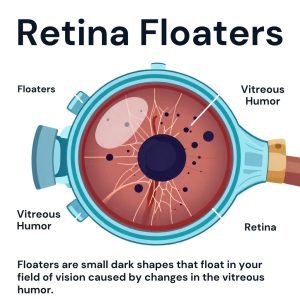
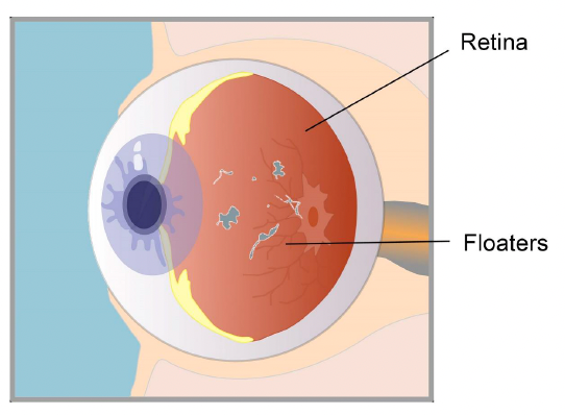
Floaters
Eye floaters are tiny spots, thread-like strands, cobwebs, or shadowy forms that wander across your field of vision. They are most typically noticed while staring at a bright background such as a blue sky, a white wall, or a computer screen.
As we become older, the vitreous, the clear jelly-like substance inside the eye, shrinks and becomes more liquid, causing floaters. Inside the vitreous, the tiny collagen fibers clump together. These clumps cast shadows on the retina and make it seem like floating spots.
Most floaters move with your eyes and slowly out of your line of vision. They are normally innocuous, but new or fast-developing floaters should never be disregarded.
Eye Floaters Causes
There are many causes of eye floaters, including normal aging and specific retinal diseases. Typical causes:
- Changes in the vitreous gel with age
- Posterior vitreous detachment (PVD)
- Retinal tears
- Retinal detachment
- injury or harm to the eye
- Eye disease caused by diabetes
- Inflammation inside the eye (uveitis)
- History of eye surgery
Posterior vitreous detachment is one of the most common explanations for the sudden noticing of floaters.
What Is Posterior Vitreous Detachment?

When the vitreous gel splits from the retina, this is called a posterior vitreous detachment (PVD). Getting this change is normal as you age, and it usually starts to happen after age 50.
Most cases of PVD don’t hurt your eyesight and only need to be watched. Even so, the vitreous may pull on the retina hard enough during the splitting process to tear it.
Patients with new floaters should get a dilated retinal exam right away from a retina specialist in Texas. It is because symptoms alone can’t tell if there is a retinal tear or not.
Why Do Flashes and Floaters Matter?
Many people have floaters and flashes at the same time.
Flashes look like short lines or flickers of light, especially when the eyes are moving or the light is dim. When the vitreous pulls on the retina, these flashes happen.
Flashes may happen sometimes as a normal part of getting older, but repeated flashes along with a sudden rise in floaters may be a sign of retinal traction or a tear.
If you don’t pay attention to these signs, a retinal tear could turn into a retinal detachment, which is an emergency that could damage your vision.
When to Seek Emergency Care?
If you notice a sudden increase in floaters, you should always consider this a possible eye emergency.
Some warning signs are:
- A rapid shower of floaters or black spots
- A lot of new floaters show up within hours
- Lots of bright lights
- A gray screen or shadow moving in front of your eyes
- Lack of side vision all of a sudden
- view that is fuzzy or distorted
These signs could be retinal tear symptoms or even a retinal detachment, both of which need immediate care to preserve the person’s vision.
Diagnosing Eye Floaters
At Texoma Retina and Glaucoma, our doctors do a full examination of your retina to find out what’s causing your symptoms.
Your review could include the following:
- Full study of the eyes
- Examining the eye with a dilation
- Higher-tech retinal scans
- Optical Coherence Tomography (OCT), when it’s appropriate
- Wide-field image of the retina
With these high-tech diagnostic tools, we can find retinal tears, detachments, and other retinal diseases that might not be obvious during a regular eye checkup.
Why Texoma Retina and Glaucoma?
At Texoma Retina and Glaucoma, we are dedicated to offering cutting-edge retinal care by using cutting-edge diagnostic tools and treatments that have been shown to work.
Our fellowship-trained retina specialists treat patients with floaters, flashes, tears, and detachments in the retina quickly and with compassion. We focus on getting the right diagnosis, making specific treatment plans, and keeping people’s long-term vision by starting treatment early.
Our skilled staff is here to help you get the specialized retinal care you need, no matter how mild or quick your symptoms are.
Medical Authority
Floaters are frequent with age and are often caused by changes in the vitreous gel in the eye.
A sudden increase in floaters may indicate a retinal tear or retinal detachment, which requires prompt retinal tear treatment.
Timely diagnosis and treatment can avoid permanent loss of vision.
Serving North Texas Communities
Texoma Retina diagnoses and treats floaters and other retinal disorders in Sherman, Gainesville, McKinney, Allen, and Paris.
Our fellowship-trained retina specialists offer comprehensive care for patients with flashes, floaters, and retinal tears. Whether you need routine monitoring or emergency retinal care, our skilled staff will protect your sight with state-of-the-art diagnostic technologies and personalized treatment.
Frequently Asked Questions
This is a normal part of getting older, and most floaters are not dangerous. But a sudden rise in floaters, especially if they are followed by flashes or vision loss, could mean that the retina is torn or detached, and you should get checked out right away.
If you notice many new floaters, flashes of light, fuzzy vision, or a shadow that looks like a curtain across your vision, you should see a doctor right away. These could be signs of a retinal emergency.
Flashes are short bursts or lines of light that happen when something presses on the retina. Floaters look like moving spots, strands, or cobwebs that move across your vision. If both signs happen at the same time, you need to see a retina specialist right away.
Most floaters that come with getting older don't need to be treated, and they usually go away on their own over time. If floaters are caused by a retinal tear or another disease of the retina, the right treatment is given to fix the problem and keep your vision safe.
Yes. A tear in the retina can make many floaters appear all of a sudden, often with flashes of light. Early diagnosis and treatment of retinal tears are critical to lower the chance of retinal detachment and loss of vision for good.
Request an
Appointment
Opening Hours
Calls are taken 24/7 for emergencies
Available on Saturday and Sunday for Emergency only. Call for appointment
LOCATIONS AND DIRECTIONS