



Goniotomy Eye Surgery in Sherman TX
What is Goniotomy?
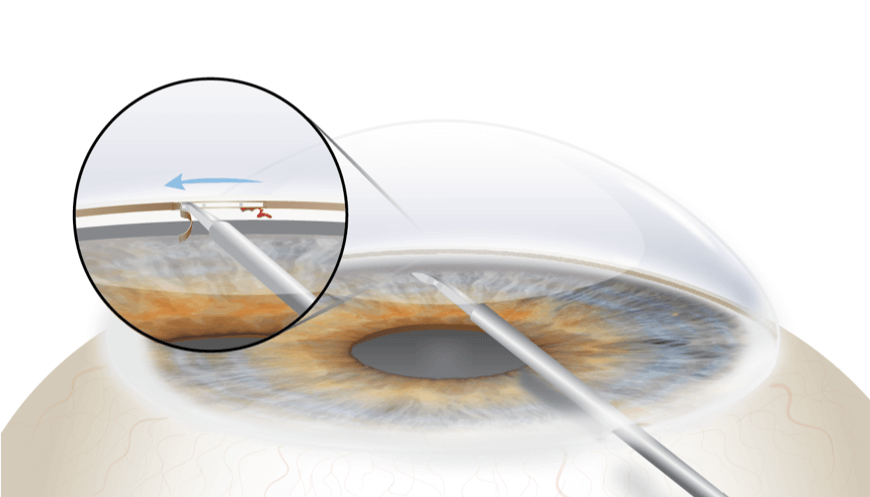
Goniotomy is a minimally invasive glaucoma surgery (MIGS) that involves making a small incision in the trabecular meshwork to improve the outflow of aqueous humor and reduce intraocular pressure (IOP). Performed under direct gonioscopic visualization with a surgical microscope, it is commonly used in both congenital and early-stage open-angle glaucoma. It can be performed alone or with other procedures, such as cataract surgery or device implantation, like the iStent or OMNI.
How does Goniotomy work?
During goniotomy, the surgeon uses a gonio lens to visualize the anterior chamber angle and then makes a small incision in the trabecular meshwork—the main drainage tissue of the eye—using specialized tools like the Kahook Dual Blade (KDB) or Sinskey hook. This incision helps bypass the resistance in the drainage system, allowing aqueous humor to flow more freely and thereby lowering IOP. Because it preserves the eye’s natural anatomy, goniotomy is associated with a favorable safety profile.
Who is a good candidate?
- Infants or children with congenital glaucoma
- Adults with mild to moderate open-angle glaucoma
- Patients with pigmentary or pseudoexfoliative glaucoma
- Those not well-controlled on medications but not yet requiring more invasive surgery
- Individuals undergoing cataract surgery who need IOP-lowering benefits
Not recommended for patients with angle-closure glaucoma, extensive angle scarring, or failed angle-based procedures.
Steps During the Procedure
- Local anesthesia and mild sedation are administered
- A surgical microscope and gonio lens are used to visualize the drainage angle
- A small incision is made in the trabecular meshwork using a KDB or similar device
- Fluid outflow improves through the newly created opening
- Antibiotics and anti-inflammatory drops are applied
What to Expect Before, During, and After
- Before: Eye exam, imaging, and pres-op instructions (such as no food or drink)
- During: Outpatient setting; takes approximately 10–15 minutes
- After: Eye drops (antibiotics and steroids) for 1–2 weeks; vision may be temporarily blurry; return to normal activity within a few days to a week. Full recovery in 2–6 weeks.
Is Goniotomy Safe?
Yes, goniotomy is considered a very safe procedure.
- Lower complication rates than traditional filtering surgeries
- Minimal trauma and no implant left in the eye
- Especially safe for pediatric and early-stage adult cases
- May be less effective in advanced glaucoma requiring more aggressive pressure lowering
Complications
While rare, possible risks include:
- Hyphema (blood in the anterior chamber)
- Transient spikes in IOP
- Inflammation or infection
- Scarring of the trabecular meshwork
- Incomplete pressure reduction requiring further treatment
Insurance and Coverage
- Typically covered by Medicare and most private insurers when medically necessary
- Common indications: primary open-angle glaucoma, ocular hypertension, congenital glaucoma
- CPT code: 65820
- If combined with cataract surgery and a device like KDB, reimbursement may vary—preauthorization is recommended
Advantages
For the right patients, goniotomy may have several benefits, including:
- Minimally invasive approach
- No external filtering
- No permanent drainage device
- Preserves the natural outflow pathway
- Can lower intraocular pressure
- May reduce dependence on glaucoma medications
- Faster recovery than some traditional glaucoma operations
- Can be combined with cataract surgery
- Preserves options for future glaucoma treatment
Regular filtering techniques cut through a lot of tissue, but goniotomy and GATT don’t. But the amount of pressure reduction depends on the type of glaucoma, how severe it is, the patient’s anatomy, and the person.
What Is GATT?
Gonioscopy-Assisted Transluminal Trabeculotomy (GATT) is a new type of minimally invasive glaucoma surgery that makes Schlemm’s canal’s trabecular outflow pathway open all the way around. A microcatheter or suture is pushed through the canal and then pulled out to make a circumferential hole. This makes it easier for the eye’s natural drainage system to get rid of the fluid. GATT is usually used for certain types of open-angle glaucoma and doesn’t need a permanent drainage device.
Goniotomy Surgery in North Texas
Complete a glaucoma evaluation to determine if angle-based surgery is appropriate for those in North Texas seeking goniotomy surgery. A glaucoma goniotomy procedure may be a therapy choice for some patients with open-angle glaucoma when medicines or laser treatment are not providing sufficient IOP control.
For some patients, goniotomy eye surgery near Sherman Texas is an option, but other alternatives may be available, such as cataract surgery with MIGS if the eye pressure, stage of glaucoma, and drainage angle architecture allow for it.
Goniotomy and Treatment of Glaucoma
There are several different types of surgery to reduce eye pressure. Goniotomy is an angle based MIGS treatment, whereas glaucoma drainage surgery, like tube shunt implantation, gives a different route for aqueous drainage. Procedures may be needed for more complex glaucoma that can achieve lower goal pressures than MIGS generally can achieve.
Open Angle Glaucoma Surgery in Durant, Oklahoma: A glaucoma expert can help patients decide if goniotomy, GATT, laser treatment, medication, or another type of surgery is best for them. Specialized glaucoma care may also be found in the nearby Sherman and North Texas area for the surrounding Southern Oklahoma communities of Durant, Hugo, Atoka, Madill, Ardmore, and others.
Local Glaucoma Care
If someone is thinking about goniotomy surgery in North Texas, goniotomy eye surgery near Sherman Texas, or open-angle glaucoma surgery in Durant, Oklahoma, they should get a full glaucoma exam at Texoma Retina in Sherman Texas, before deciding on treatment. In minimally invasive glaucoma surgery and eye pressure reduction surgery, there isn’t a single procedure that works for everyone who has glaucoma. The right procedure depends on the patient’s glaucoma type, severity, target IOP, medications, anatomy, and previous procedures.
Frequently Asked Questions
It cuts away or opens up a part of the trabecular meshwork, which makes it easier for the aqueous humor to leave through the natural drainage pathway.
It is usually thought of for some people with open-angle glaucoma, like mild to moderate cases and some secondary glaucomas.
A goniotomy cuts out a piece of the trabecular meshwork, and a GATT makes a trabeculotomy around Schlemm's canal.
Yes. Individuals who are a good candidate for goniotomy can have surgery alone or along with eye surgery.
The length of the procedure depends on the technique used, whether other surgeries are being done at the same time, and the specifics of each patient's case.